
Deposits & Withdrawals
OKX SEPA Guide (2026): Deposit and Withdraw Euros
How to move euros in and out of OKX by SEPA: eligibility under the MiCA-licensed European entity, deposit and withdrawal steps, fees, timing and rejection causes.
Reviewed on August 21, 2026. Fees, product availability, tax and regulatory rules can change. Verify live platform screens and official sources before acting.
Short answer: OKX serves the European Economic Area through its MiCA-authorised European entity, and eligible verified users can move euros in and out by SEPA bank transfer. OKX states that it does not charge a platform fee for EUR SEPA withdrawals for eligible European users, with processing running from near-instant to two business days depending on the receiving bank. As always, the figure on your own withdrawal screen is the one that binds.
Most euro on-ramp guides for crypto are written about Binance, because Binance has been in Europe longest. That leaves a gap: plenty of readers are on OKX, or want a second euro rail so that one banking-partner change does not strand them. This is the OKX version of the walkthrough.
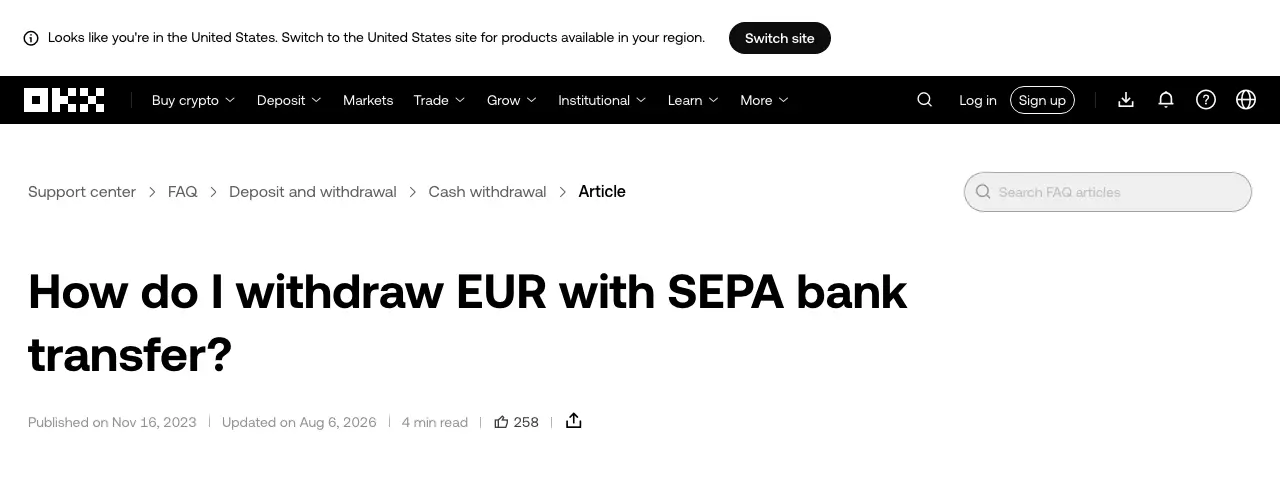
OKX Europe's official SEPA withdrawal guide, captured August 12, 2026. Eligibility, fees and timing remain account- and region-dependent.
Before you start: eligibility and verification
Three conditions gate the euro rails, and all three are worth confirming before you move money.
You need a European entity account. OKX operates in the EEA through a MiCA-licensed European entity. Euro SEPA services are offered to users onboarded there; an account opened under a different regional entity will not show the same fiat options. If the EUR deposit method simply is not in your menu, this is usually why.
You need completed identity verification. SEPA transfers are matched against a verified account holder. An unverified account cannot receive a euro transfer, and the money will not sit waiting politely — it gets returned, with the delay that implies. Our OKX account and KYC walkthrough covers the documents and the common rejection causes.
Your bank account must be in your own name. This is the rule that catches the most people, and it is not negotiable anywhere in European crypto. The name on the bank account must match the name verified on your OKX account. A spouse's account, a parent's account, a business account when you verified as an individual — all of these are third-party transfers, and they are refused on principle.
Depositing euros by SEPA, step by step
- Log in and open the fiat deposit section. Choose EUR, then bank transfer (SEPA) as the method.
- Read the screen before you touch your banking app. It shows the beneficiary details, the reference or payment ID if one is required, the applicable fee, and the minimum. These are account-specific and can change; do not reuse details you saved months ago.
- Copy the beneficiary IBAN, the beneficiary name and the reference exactly as displayed. If a reference is shown, it is what links the incoming money to your account.
- In your banking app, create a euro transfer from an account in your own name. Choose instant if your bank offers it — under the EU Instant Payments Regulation it should not cost more than a standard transfer, and it settles outside business days. The rails are compared in SEPA Instant vs standard SEPA.
- Send, then check the transaction detail in your banking app to confirm which scheme was actually used. Banks routinely downgrade instant transfers that exceed an internal limit.
- Wait. An instant transfer to an established account is usually credited within minutes. A first deposit adds a one-off compliance check that can run to hours.
A note on the beneficiary details: fiat rails depend on banking partners, and banking partners change. Binance users learned this in September 2023, when its EUR partner stopped serving it and everyone had to update their saved beneficiary. The habit that protects you on any platform is the same — re-read the deposit screen each time rather than trusting a saved template.
Withdrawing euros by SEPA, step by step
- Make sure the balance is actually in EUR. If it is still in crypto, sell it on the spot market or convert it first. That choice is where the real cost of an exit lives, not in the withdrawal fee — see SEPA withdrawal fees compared.
- Open fiat withdrawal, choose EUR, then bank transfer (SEPA).
- Add the destination IBAN. It must be an account in your verified name. A first withdrawal to a never-used IBAN normally triggers an ownership check — extra documents, extra hours. This is standard compliance behaviour, not a sign of a problem.
- Review the fee and the estimated arrival shown on the confirmation screen, then approve with your usual security verification.
- Expect anywhere from near-instant to two business days, depending on your bank and on whether the compliance review completes immediately.
Fees and timing: what OKX states
| Item | What to expect |
|---|---|
| EUR SEPA withdrawal, platform fee | OKX states no platform fee for eligible European users |
| Your own bank's receiving fee | Free at virtually every euro-zone bank |
| Published processing estimate | Near-instant to two business days, depending on the receiving bank |
| Deposit fee and minimum | Shown on the live deposit screen; account- and region-dependent |
| Limits | Tied to your verification level — check your own account pages |
| Crypto-to-EUR conversion | The real cost line: spot fee around 0.08–0.10%, or a convert spread of roughly 0.3–1% |
That last row is the one to internalise. A "free" withdrawal after a 0.5% convert spread costs you far more than a 1 EUR withdrawal after a 0.1% spot sale. On a 1,000 EUR exit the gap is a few euros; on 10,000 EUR it is a few dozen. Referral pricing helps here too — signing up with code OK6669 applies a 20% trading-fee discount, which reduces the sale line rather than the withdrawal line.
The four rules that get euro transfers rejected
- Name mismatch. The bank account holder must be the verified account holder. Since October 2025, euro-area banks also run Verification of Payee on outgoing transfers, so a mismatched beneficiary name is now often flagged before you even confirm.
- Third-party or joint accounts. Even where you are one of the holders, a joint account is treated as third-party by most crypto platforms. Use a personal account in your sole name.
- SWIFT instead of SEPA. A euro payment routed internationally as SWIFT does not travel the SEPA channel and will not be processed as one. If your bank offers both, pick SEPA explicitly.
- A missing reference. Where the deposit screen shows a reference or payment ID, a transfer without it cannot be matched automatically.
If a transfer has already come back to your bank, the diagnosis path is in SEPA transfer rejected by a crypto exchange. If it simply has not arrived, work through SEPA deposit pending instead — a returned transfer and a missing one have different causes and different fixes.
OKX or Binance for euros?
Both run euro rails in Europe, and for most users the deciding factor is not the headline withdrawal fee.
- Withdrawal fee: OKX states none for eligible European users; Binance's published fee is usually around 1 EUR. On a monthly exit, the difference is roughly the price of a coffee per year.
- Deposit minimum: Binance sets a hard 2 EUR floor and does not credit or refund transfers below it. Never send a 1 EUR test to Binance.
- Country coverage: Binance's SEPA channel covers 36 SEPA countries but excludes the Netherlands entirely. Dutch users need an alternative, and that alone makes a second euro rail worth having.
- Trading cost: this is where the money is. The full breakdown is in OKX vs Binance fees, and the Binance euro walkthrough is in the Binance SEPA guide.
The honest recommendation is not "pick one". It is to have a verified euro path on two platforms, because fiat rails are the part of this industry that breaks without warning.
FAQ
Does OKX charge for SEPA withdrawals? OKX states that eligible European users are not charged a platform fee for EUR SEPA withdrawals. Verify the amount on your own withdrawal screen before confirming — eligibility is account- and region-dependent.
How long does an OKX SEPA withdrawal take? The published estimate runs from near-instant to two business days, depending on your receiving bank. A first withdrawal to a new IBAN adds a compliance check.
Can I withdraw to my partner's bank account? No. The destination IBAN must belong to the verified account holder. Third-party withdrawals are refused and can trigger a review of your account.
Is OKX available in my country? EEA availability runs through the MiCA-licensed European entity, and the exact country list can change. If the EUR SEPA option does not appear in your account, it is not available to you at present — no workaround exists, and looking for one is a bad idea.
What about taxes on the euros I withdraw? Turning crypto into euros is a taxable event in most regimes. For French residents, start with crypto taxes in France and the Form 2086 filing guide. Export your trade history at withdrawal time, not at filing time.
Affiliate disclosure: this article contains referral links. If you sign up on OKX (code OK6669) through our links, you get a 20% discount on trading fees and this site earns an affiliate commission, at no extra cost to you.
Risk warning: cryptocurrencies are volatile, high-risk assets; you may lose your entire capital. This content is educational and informational only and is not financial, legal or tax advice. Do your own research before trading.
Regional notice: this site is aimed at French-speaking markets (Europe and francophone Africa). It is not directed at residents of mainland China, the United States, the United Kingdom or Canada. Check and comply with the regulations in force in your country.