
Taxes & Declarations
France Crypto Tax Form 2086: A Practical Filing Guide
A practical guide for French tax residents completing Form 2086: taxable disposals, portfolio value, acquisition cost, the €305 threshold and foreign-account forms.
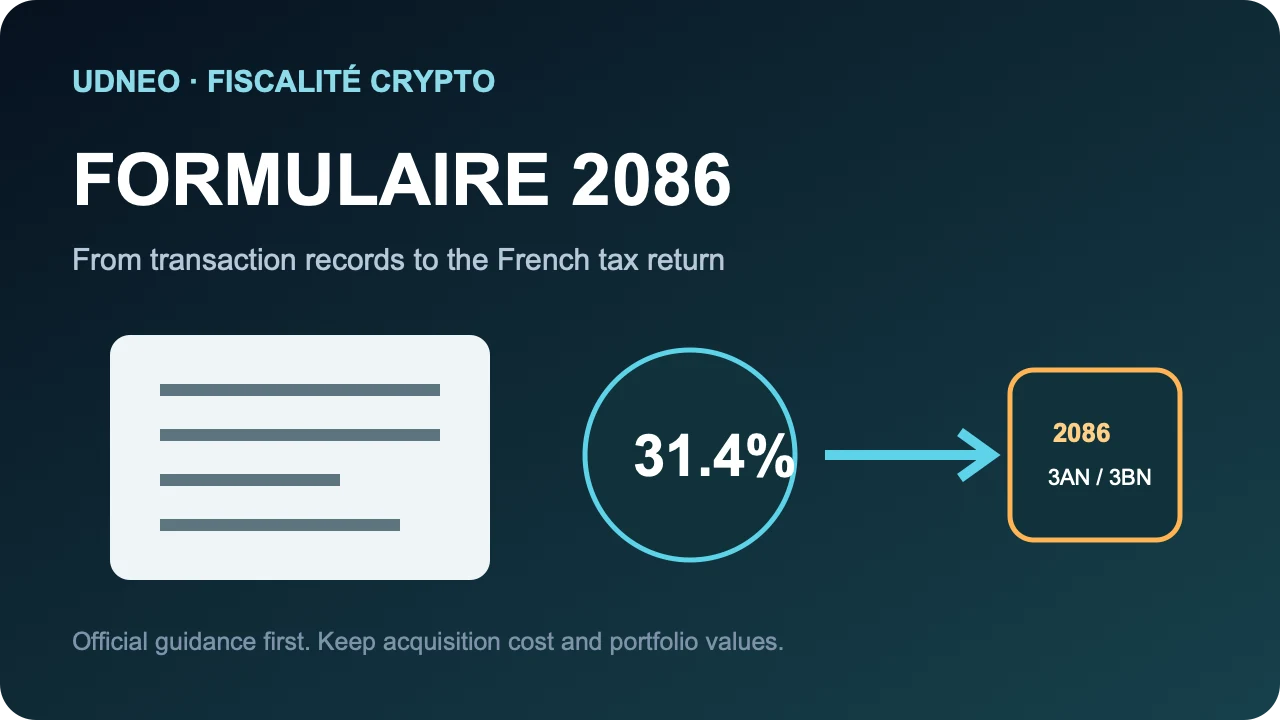
Form 2086 is where a French tax resident details taxable disposals of digital assets. It is not a list of every wallet movement. The difficult part is usually reconstructing the total portfolio value and acquisition cost at each taxable disposal, not typing the final number into the form.
This guide concerns the 2026 filing season for 2025 income and uses current official material. It is general information, not personal tax advice.
First decide which events belong on the form
For a private investor, taxable disposals generally include selling crypto for legal tender and using crypto to buy goods or services. Crypto-to-crypto swaps without a cash adjustment are generally treated as interim transactions rather than immediately taxable disposals.
The French tax authority's digital-asset filing guide distinguishes private and professional activity and explains the associated forms.
Create a transaction list with one row for each potentially taxable disposal. Separate internal wallet transfers, purchases and crypto-to-crypto swaps so they are not counted as euro exits.
The €305 threshold is about disposal proceeds
The exemption applies when the household's total disposal prices during the year do not exceed €305. It is not a €305 profit allowance. Once total disposals exceed the threshold, the calculation concerns the year's taxable disposals under the applicable rules.
Do not confuse this threshold with the amount remaining in your wallet.
Data required for each disposal
The official 2026 Form 2086 PDF asks for information including:
- disposal date;
- global portfolio value at that moment;
- disposal price;
- disposal fees;
- cash adjustment, if any;
- total acquisition cost of the portfolio;
- previous fractions of acquisition cost already deducted.
“Global portfolio” is broader than one exchange account. It can include assets on other platforms and self-hosted wallets. Missing a wallet distorts the proportional calculation.
Reconstruct the portfolio value
Choose a consistent valuation source and preserve evidence. At the timestamp of each taxable disposal:
- list every digital asset and wallet held by the household;
- obtain a defensible market value in euros;
- include exchange and self-custody balances;
- record the source and timestamp;
- retain CSV exports and screenshots.
Stablecoins are digital assets too. A USDT balance forms part of portfolio value even when close to one US dollar.
The proportional gain formula
The official calculation is based on the disposal price minus a proportion of total acquisition cost. In simplified form:
taxable gain = net disposal price − [total portfolio acquisition cost × net disposal price ÷ global portfolio value]
This is why simply subtracting the purchase price of “the Bitcoin sold” may be wrong under the French private-investor regime.
From Form 2086 to the main return
After completing the detail, the annual net result feeds the relevant boxes on the main return, commonly 3AN for a net gain or 3BN for a net loss. The online filing flow can carry the result from the annex.
For 2026, official guidance states that private digital-asset gains fall under a 31.4% flat levy—12.8% income tax plus 18.6% social contributions (under the 2026 social security financing law, which raised social levies on capital income from 17.2% to 18.6%)—with an option for the progressive scale in qualifying circumstances. Check the live filing interface because individual situations differ.
Foreign exchange accounts: separate obligation
Form 2086 calculates gains. It does not replace the declaration of foreign digital-asset accounts. French residents may also need Form 3916-3916 bis for accounts opened, held, used or closed abroad.
Prepare the provider's legal name, address, account identifier and opening or closing date. The legal entity matters more than the app's brand.
A reconciliation checklist
| Check | Why it matters |
|---|---|
| Opening balances + purchases − disposals = closing balances | Finds missing transactions |
| All exchanges and wallets included | Prevents an incomplete portfolio value |
| Fees recorded once | Avoids double deduction |
| Transfers matched between your wallets | Prevents false disposals |
| Euro proceeds matched to bank records | Supports the reported disposal price |
| CSV files archived | Preserves evidence after platforms change formats |
Frequent mistakes
- reporting only withdrawals to the bank and missing crypto purchases of goods;
- treating every crypto-to-crypto swap as a fiat disposal;
- applying the €305 threshold to profit instead of disposal proceeds;
- valuing only the account where the sale occurred;
- forgetting foreign-account reporting;
- changing valuation methods without documentation.
Read our broader France crypto tax overview and bank cash-out guide for the events that feed this form.
FAQ
Do I file 2086 if I only bought and held? A purchase and simple holding do not create a disposal, but foreign-account reporting may still apply.
What if I have hundreds of disposals? Use reliable records or specialist software, then reconcile its output with the official formula rather than submitting an unchecked total.
Can I use an exchange tax report blindly? No. Confirm that it includes every wallet, uses French rules and values the total portfolio at each disposal.
Tax warning: rules and rates can change, and professional or business activity follows different treatment. Consult a qualified adviser for material amounts or complex facts.