
Deposits & Withdrawals
Binance SEPA Guide (2026): Fees, Times, Limits & Fixes
How to deposit and withdraw EUR on Binance with SEPA: live fees, processing times, account-name and reference rules, limits, and fixes for delayed transfers.
Short answer: Binance SEPA lets eligible users deposit and withdraw euros by bank transfer. Fees, limits and availability vary by account and country, so the amount shown on the confirmation screen is authoritative. As a planning guide, allow up to 24 hours for SEPA Instant deposits, up to 3 business days for standard deposits, and 1–3 business days for withdrawals.
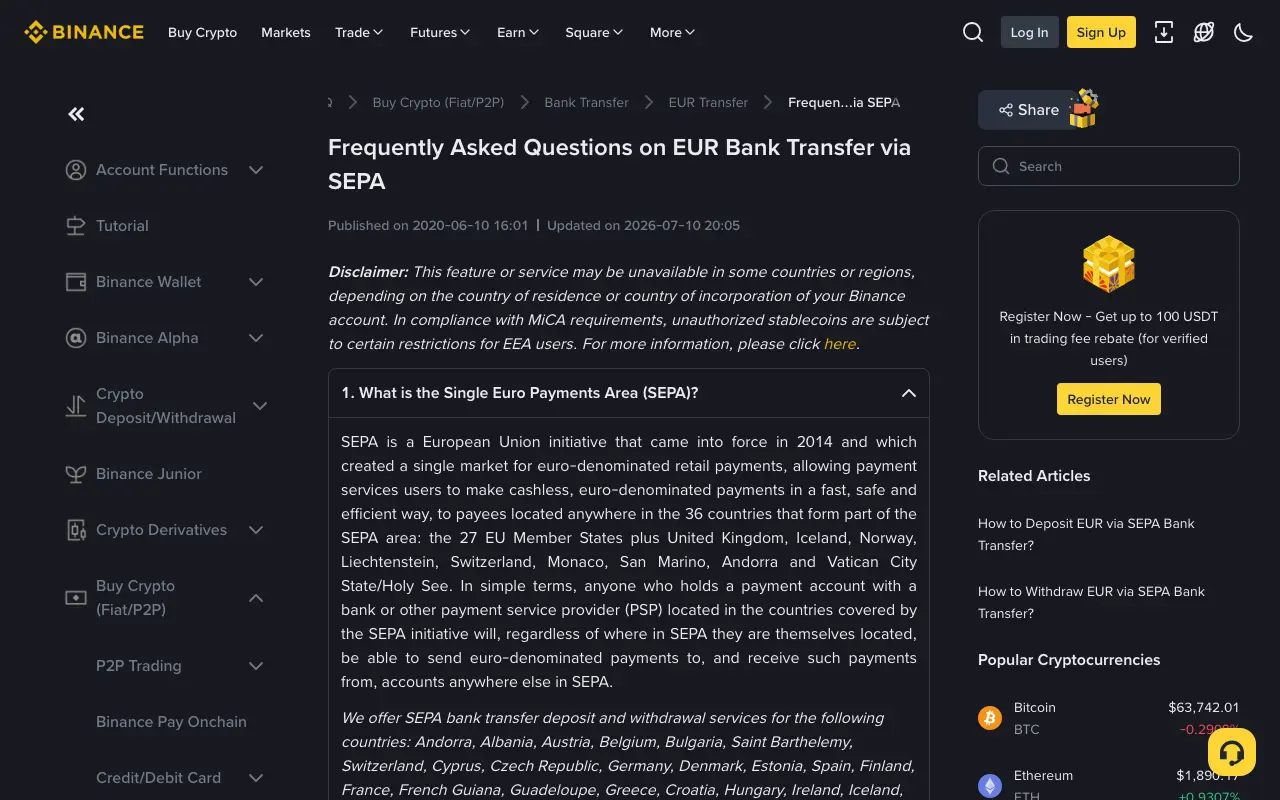
Binance's official SEPA FAQ, captured August 12, 2026. Availability and the live fee shown in your account take precedence over third-party guides.
One promotion deserves a warning up front. From 3 November 2025, Binance ran a zero-fee SEPA Instant deposit campaign for verified users in the European Economic Area. That campaign ended on 4 March 2026. Plenty of older articles and forum posts still promise free SEPA deposits — do not plan around them. The rate that applies to you is the one displayed in real time on the deposit page after you log in, and as of our July 2026 check the standard fee is back.
How to deposit EUR via SEPA, step by step
The deposit flow itself is simple, but Binance enforces several hard rules, and breaking any of them will get your money delayed, returned, or in one specific case lost. Read the rules before you send anything.
- Log in to Binance and complete identity verification if you have not already. SEPA transfers are only matched against a fully verified account.
- Go to the fiat deposit section, choose EUR, and select SEPA or SEPA Instant as the payment method. The fee for each option is displayed on this screen — this is the number that counts, not what any third-party article says.
- Binance shows you a dedicated IBAN, the beneficiary name, and a reference code. Copy all three exactly.
- Open your banking app and create a euro transfer to that IBAN. Paste the reference code into the payment reference or message field. This code is how Binance matches the incoming money to your account; a transfer without it is not credited automatically.
- Send the transfer from an account held in your own name — the same name as on your Binance verification. Send at least 2 EUR.
- Wait for the credit: up to 24 hours for SEPA Instant, up to 3 business days for standard SEPA.
Four rules are non-negotiable:
- Name match. The bank account holder name must be identical to the verified name on your Binance account. Transfers from someone else's account are rejected.
- No joint accounts. Binance does not accept SEPA transfers from joint bank accounts, even if you are one of the holders. Use a personal account only.
- Reference code is mandatory. Forgetting it is the single most common cause of "missing" deposits.
- No SWIFT. The SEPA channel only accepts SEPA payments. If your bank routes the transfer as an international SWIFT payment instead of SEPA, it will not go through this channel.
And the rule that can actually cost you money: transfers below 2 EUR are neither credited nor refunded. If you like to send a small test transfer before a large one — normally a sensible habit — make that test at least 2 EUR, never 1 EUR.
How to withdraw EUR via SEPA, step by step
- Make sure the balance you want to cash out is actually in EUR. If it is sitting in crypto, sell it into EUR on the spot market or use Convert first (more on the EEA-specific USDT situation below).
- Go to fiat withdrawal, choose EUR, and select bank transfer (SEPA).
- Enter the IBAN of a bank account held in your own name — again, the name must match your Binance verification, and joint accounts are not accepted.
- Enter the amount, review the fee displayed on screen, and confirm with your usual security verification.
- The money should reach your bank within 1 to 3 business days.
If a withdrawal has not arrived after 24 hours, do not just wait passively. Go to Orders → Fiat Order in your Binance account, find the transaction, and contact support from there with the order reference. That is the official escalation path.
Binance SEPA fees, limits and processing times
| Item | What Binance's official pages say |
|---|---|
| SEPA deposit fee | Usually 1 EUR per transfer (e.g. 100 EUR via SEPA Instant → 1 EUR fee) |
| SEPA withdrawal fee | Usually 1 EUR per transfer |
| Official fiat channel fee range | 0.3 EUR to 1.2% per transaction, depending on channel |
| Minimum transfer | 2 EUR — anything below is not credited and not refunded |
| Deposit time (SEPA Instant) | Up to 24 hours |
| Deposit time (standard SEPA) | Up to 3 business days |
| Withdrawal time | 1–3 business days |
| Limits | Depend on your KYC level — check the Identification page in your account |
On limits: Binance does not publish a single universal table of SEPA limits. They vary with your verification level, and the only authoritative numbers are the ones shown on your own Identification page. If a figure matters for your planning — say, a large withdrawal — check it there before you start.
To see how Binance's 1 EUR flat fee stacks up against other exchanges, we keep a separate comparison updated at SEPA withdrawal fees compared across platforms.
SEPA Instant vs standard SEPA: speed and processing
Both options ride the same European payments network and, on Binance's side, the fee logic is the same "usually 1 EUR" per transfer. The difference is speed and bank support:
- SEPA Instant is credited within 24 hours at the latest, and often much faster in practice. It requires your bank to support instant payments on its side.
- Standard SEPA can take up to 3 business days, and a Friday-evening transfer may not be credited until the middle of the following week.
If your bank supports instant payments at no extra charge, SEPA Instant is the obvious choice for deposits: same Binance fee, much less waiting. Standard SEPA remains a fine fallback when your bank does not offer instant transfers or charges extra for them.
How long does a Binance SEPA deposit take in practice?
The official windows above are ceilings, not forecasts. What actually decides when the money lands is which rail your bank used and what time you pressed send.
| When you send it | SEPA Instant | Standard SEPA |
|---|---|---|
| Weekday, banking hours | Minutes to a few hours | Next business day |
| Weekday evening | Minutes to a few hours | Next business day |
| Friday evening | Minutes to a few hours | Often Monday, sometimes Tuesday |
| Saturday or Sunday | Minutes to a few hours | Nothing moves until Monday |
| Public holiday | Minutes to a few hours | Clock restarts on the next business day |
| Your first-ever deposit | Add a one-off compliance check | Add a one-off compliance check |
That table is the whole argument for SEPA Instant: the instant rail settles outside the business-day calendar, so a Sunday transfer is credited on Sunday. Standard SEPA queues behind the next banking day. Since the Binance-side fee is the same "usually 1 EUR" either way, the only reasons to pick standard SEPA are that your bank does not offer instant payments, or charges extra for them.
Two caveats worth knowing before you rely on the instant rail. First, "instant" describes the payment network, not Binance's internal processing — a first deposit, or an unusually large one, can still sit in review regardless of how fast the money arrived. Second, many retail banks cap instant payments at a few thousand euros and silently downgrade anything above the cap to a standard transfer, without telling you at the point of sending. If a deposit you expected within minutes has not appeared, open your banking app and check which of the two your bank actually sent before you contact support.
Both rails, including the withdrawal direction, are compared in detail in SEPA Instant vs standard SEPA.
Troubleshooting: the most common SEPA problems
My deposit has not arrived. First, check the clock against the official windows: 24 hours for SEPA Instant, 3 business days for standard SEPA. Then verify the three usual suspects — did you include the reference code, did you send from an account in your own (matching) name, and was the amount at least 2 EUR? If the window has passed, go to Orders → Fiat Order and open a support request against that specific order. Binance's own SEPA transfer FAQ covers the standard cases.
My withdrawal is stuck. The stated window is 1–3 business days. After 24 hours without arrival you can already contact support through Orders → Fiat Order — you do not need to wait the full three days to ask.
I live in the Netherlands. SEPA on Binance covers 36 SEPA countries, but the Netherlands is the notable exception: Dutch users cannot use the SEPA channel at all. If your bank account is Dutch, this guide's deposit and withdrawal flows are simply not available to you on Binance.
My transfer came from a joint account and was returned. This is expected behaviour, not a bug. Binance rejects joint accounts outright. Re-send from a personal account in your sole name that matches your Binance verification.
My bank sent it as SWIFT. SWIFT payments cannot use the SEPA channel. Ask your bank to send a proper SEPA (or SEPA Instant) credit transfer in EUR.
My transfer was rejected and returned to my bank. A returned transfer is a different problem from a missing one, and it has its own short list of causes — name mismatch, joint account, a bank that blocks crypto-linked beneficiaries, or a compliance decision on the platform side. We work through each of them in SEPA transfer rejected by a crypto exchange.
A structural point worth knowing: the SEPA channel depends on banking partners, and that dependency has bitten users before. Binance suspended SEPA deposits in July 2021, and on 25 September 2023 its partner Paysafe stopped providing EUR SEPA services to Binance entirely, forcing users to update their bank details. Neither event cost users their funds, but both caused disruption. The practical lesson: do not treat any single fiat on/off-ramp as permanent, and do not leave a time-critical cash-out to the last day. Keeping a second verified euro on-ramp open is cheap insurance — OKX runs its own euro rails in Europe, and the equivalent step-by-step is in the OKX SEPA guide.
EEA users: the USDT detour
If you hold USDT and want to cash out by SEPA, there is an extra step in the European Economic Area. Since 31 March 2025, USDT spot trading pairs have been delisted for EEA users. You can still hold USDT, deposit and withdraw it on-chain, and use it in Convert — but you cannot sell it against EUR on the spot order book.
The practical route is: use Convert to swap USDT into EUR (or into another asset that still has a EUR spot pair), then withdraw the EUR via SEPA as described above. Cost-wise, keep in mind the trade-off: spot EUR pairs carry a base maker/taker fee of 0.1% (reducible with the BNB discount), while Convert charges no explicit fee but builds its margin into the quoted rate as a spread. For small amounts the difference is negligible; for large conversions, compare the Convert quote against the live spot price before accepting.
FAQ
How much does a Binance SEPA deposit cost in 2026? Usually 1 EUR per transfer. The zero-fee EEA promotion that started on 3 November 2025 ended on 4 March 2026, so ignore older articles promising free deposits. The binding figure is the one on your deposit screen.
What is the minimum SEPA deposit? 2 EUR. Transfers below that are not credited and not refunded — this is the one mistake that genuinely loses money, so never send a 1 EUR test.
How long does a SEPA withdrawal from Binance take? 1 to 3 business days. After 24 hours without arrival, contact support via Orders → Fiat Order.
Can I deposit from my partner's account or a joint account? No. The account holder name must match your Binance verified name exactly, and joint accounts are refused even if your name is one of the holders.
What are my SEPA deposit and withdrawal limits? They depend on your KYC level. Binance publishes no universal figures — check the Identification page in your own account.
Does Binance SEPA work in the Netherlands? No. Binance supports 36 SEPA countries, but the Netherlands is excluded from the SEPA channel.
Disclaimer
Fees, processing times and availability described here are based on Binance's official FAQ and announcements and were last verified in July 2026. Binance can change its fee schedule, banking partners and country coverage at any time — the July 2021 deposit suspension and the September 2023 Paysafe exit are proof of that. Always treat the figures shown on the official deposit and withdrawal pages after login as authoritative. This article is informational only and is not financial advice.