
Comparisons & Fees
How to Verify a Crypto Exchange Proof of Reserves
A reserve ratio above 100% is only the first check. Learn how to verify wallet ownership, user-balance inclusion, liabilities and the limits of a point-in-time snapshot.
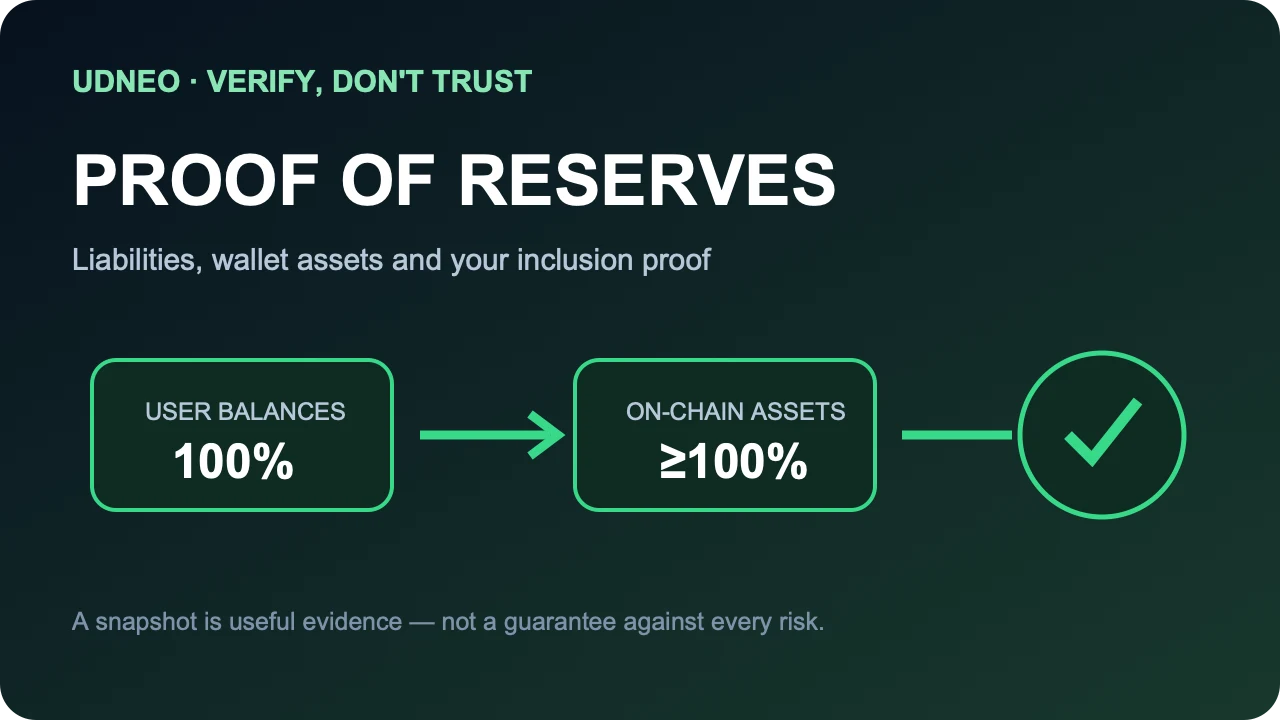
A large “reserve ratio” number is not enough to verify an exchange. A meaningful proof of reserves connects three questions: what the platform owes users, which on-chain assets it controls, and whether your own balance was included in the liability snapshot.
This guide uses OKX's public process as a worked example, but the same framework can be applied to any custodial platform.
Start with the accounting equation
For each covered asset, the basic claim is:
verifiable reserve assets ÷ included user liabilities ≥ 100%
The numerator should be assets controlled by the custodian. The denominator should represent user balances included in the report. A platform showing wallets without a credible liability calculation has not answered whether those wallets cover what customers are owed.
Check 1: report date and asset scope
Proof of reserves is a snapshot. Record its date and list of supported assets. Tokens outside the report, balances created after the snapshot and products held through third-party custodians may require different evidence.
The OKX proof-of-reserves page publishes current ratios and explains that its reports cover a defined set of assets. Do not generalize a BTC ratio to every token on the platform.
Check 2: wallet ownership
An on-chain balance is useful only if the exchange can demonstrate control of the address. Typical evidence includes signed messages, published address lists and open-source verification tools.
For a deeper check:
- Download the address or reserve file from the official report page.
- Verify its checksum or signature when supplied.
- Use the platform's open-source tool in an isolated environment.
- Compare selected wallet balances with independent block explorers.
- Confirm that the report explains third-party custody separately.
OKX documents a wallet ownership and balance verification process. Download tools only from the official page or linked repository.
Check 3: your inclusion proof
Merkle-tree or zero-knowledge systems are intended to prove that a user's balance contributed to the liability total without exposing everyone else's balance. When your account offers a report:
- open the Proof of Reserves section while logged in;
- obtain the record or identifier for the snapshot;
- verify the inclusion result using the documented method;
- save the result and report date;
- confirm which account types were included.
A successful inclusion proof means your snapshot balance was counted. It does not prove that every other account is free of hidden liabilities.
Check 4: negative balances and liabilities
A weak design can inflate confidence if negative user balances are omitted or if loans and off-chain obligations are ignored. Read how the proof prevents negative balances from reducing total liabilities. OKX says it uses zk-STARK constraints to account for balances while preserving privacy; the important point is the constraint design, not the acronym itself.
What proof of reserves does not prove
| It can support | It cannot guarantee by itself |
|---|---|
| Assets existed at snapshot time | Assets remained there after the snapshot |
| Published wallets were controlled | No undisclosed corporate liabilities exist |
| Your balance was included | The exchange will never be hacked |
| Covered assets met a ratio | Every token and product is equally covered |
| A cryptographic calculation verified | Governance and risk controls are sound |
This is why proof of reserves should be combined with regulation, financial disclosures, withdrawal tests and sensible custody limits. Read our OKX review and wallet-versus-exchange guide for those other layers.
A five-minute monthly routine
- Check that a new report was published on schedule.
- Compare ratios with the previous month.
- Verify your inclusion proof when available.
- Review major wallet movements using an explorer.
- Test a small withdrawal after material platform changes.
Do not wait for rumors before checking. A short repeatable process is more useful than reading marketing claims once.
FAQ
Is 100% enough? It is the minimum mathematical coverage for the included asset and liabilities, not a complete safety score.
Does a third-party audit replace cryptographic verification? They answer different questions. Independent assurance can examine processes and liabilities; cryptographic proof can make specific snapshot claims reproducible.
Should I keep all funds on an exchange with PoR? Proof of reserves reduces one information gap. It does not remove custody, operational or market risk.
Disclosure: reserve figures change over time. Use the official current report rather than values quoted in an older article.