
Comparisons & Fees
OKX Earn & Staking Guide (2026): Products, Returns and Risks
Understand OKX Simple Earn Flexible, fixed-term lending and on-chain staking: where returns come from, redemption rules, lock-ups and principal risks.
Reviewed on August 12, 2026. Fees, product availability, tax and regulatory rules can change. Verify live platform screens and official sources before acting.
2026 action checklist
- Identify where the yield comes from and who holds the assets.
- Check lock-up, redemption delay and whether the advertised rate is variable.
- Do not treat a high APY as equivalent to a guaranteed savings rate.
OKX Simple Earn and on-chain staking are different products with different yield sources, redemption rules and risks. Simple Earn Flexible lends assets to platform borrowers; staking depends on blockchain rewards. Neither should be treated as a guaranteed bank savings account.
The main product families
1. Flexible savings
You lend your crypto (most commonly stablecoins like USDT) into the platform's lending market; interest accrues continuously and you can withdraw at any time.
- Realistic yield: a few percent per year on stablecoins in normal conditions; the rate floats with borrowing demand.
- Main risks: platform and borrower exposure, variable rates, and liquidity. OKX says flexible redemption is normally available 24/7, but it may be temporarily restricted if the lending pool is fully utilized. Simple Earn is not principal-protected.
2. On-chain staking
For proof-of-stake assets (ETH, SOL, ADA…), OKX delegates your tokens to validators and passes through the network rewards.
- Realistic yield: whatever the protocol pays — typically 2–6% per year depending on the asset.
- Risks: lock-up or unbonding periods on some assets (you cannot always exit instantly), a small but real technical risk (slashing), and platform risk as always.
3. Promotional and discovery offers
High rates on small caps, limited to new users or short windows. Useful for testing the flow; irrelevant at portfolio scale.
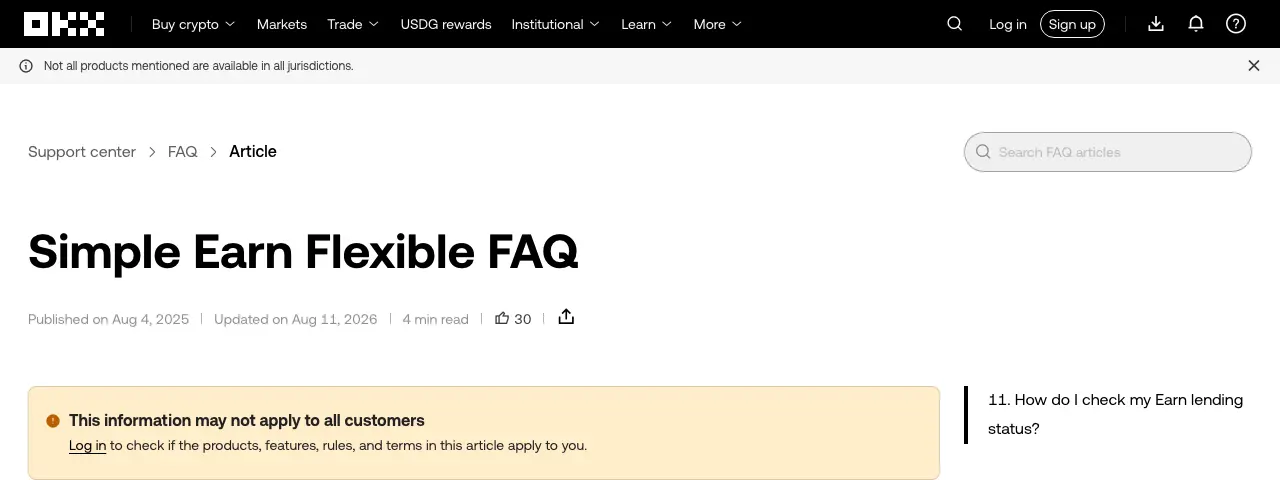
OKX's official Simple Earn Flexible FAQ, captured August 12, 2026. Product access and terms vary by jurisdiction and account.
OKX staking in detail: lock-ups, unbonding and what "flexible" really means
"Staking" on an exchange covers several different mechanics, and the label on the button rarely tells you which one you are buying. Before subscribing, work out which row of this table you are actually in.
| Product shape | Where the yield comes from | Getting your money back |
|---|---|---|
| Flexible savings (stablecoins) | Interest paid by borrowers on the platform's lending market | Normally on demand, but can be restricted when the lending pool is fully drawn |
| Flexible staking (ETH, SOL…) | Network rewards, with the platform absorbing the exit queue | Usually quick, because the platform fronts the liquidity |
| Locked / fixed term | A higher rate in exchange for a fixed commitment | Not before term; early exit is either impossible or forfeits the accrued reward |
| On-chain staking, direct | The protocol itself | Subject to the network's real unbonding queue — hours to weeks depending on the chain and how busy it is |
The last row is the one that surprises people. An exit queue is a property of the network, not a setting the platform controls: when many validators leave at once the wait stretches, and no exchange can shorten it. If you might need a specific asset on a specific date, do not put it in a product whose exit depends on a queue you cannot see.
Two more things to check on the product sheet before you subscribe:
- Is the advertised rate a headline tier? Platforms commonly pay a high rate on a first small tranche and a much lower one above it. The blended rate on a meaningful balance is what you will actually receive, and it is usually a long way below the number in the banner.
- Is the rate fixed or variable? Flexible stablecoin rates float with borrowing demand and can halve in a quiet market. A rate you saw last month is not a rate you are owed.
One structural point that applies to every row: subscribing to any of these products means your assets stay with the platform, so the yield is compensation for counterparty risk. That is a reasonable trade at some sizes and a poor one at others — which is the subject of the self-custody section below.
The golden rule: yield comes from somewhere
A stablecoin rate far above the market means more risk — riskier borrowers, less liquid tokens, or a temporary promotion. Treat any product promising a high guaranteed fixed return as a red flag: "guaranteed yield" is exactly the language investment scams recycle.
How to subscribe (example: USDT savings)
- From your OKX account (code OK6669, 20% fee discount if you don't have one yet), open Grow / Earn.
- Search the asset (USDT, ETH…), compare flexible vs locked products.
- Read the product sheet: yield source, lock-up duration, exit conditions.
- Subscribe a small test amount, watch a reward cycle, then adjust.
Earn and taxes
Earn and staking rewards are taxable events or taxable income in most jurisdictions — for residents of France, see our plain-English tax overview. Keep a record of every payout — dates, amounts, market value — whatever your country's regime.
Earn or self-custody?
Yield from Earn requires keeping funds on the platform. For substantial long-term holdings, the trade-off between yield and counterparty risk sometimes favors self-custody instead — our guide crypto wallet or exchange: where to keep your coins covers exactly that decision. For context on the platform itself, see our OKX review 2026.
FAQ
Can I lose money in flexible savings? The main loss scenario is a platform failure — hence the value of OKX's proof of reserves, and of not concentrating all savings in one place.
Is ETH staking locked? Unstaking depends on network queues and the product; expect anywhere from hours to several days.
What is the minimum? Most products accept the equivalent of a few dollars — ideal for testing before committing more.
Affiliate disclosure: this article contains referral links. If you sign up on OKX (code OK6669) through our links, you get a 20% discount on trading fees and this site earns an affiliate commission, at no extra cost to you.
Risk warning: cryptocurrencies are volatile, high-risk assets; you may lose your entire capital. This content is educational and informational only and is not financial, legal or tax advice. Do your own research before trading.
Regional notice: this site is aimed at French-speaking markets (Europe and francophone Africa). It is not directed at residents of mainland China, the United States, the United Kingdom or Canada. Check and comply with the regulations in force in your country.